Bitcoin & Cryptocurrency Prices by Market Cap
Top Coins
#
Coin
Price
24h
Market Cap
Volume
7 day trend
Actions
Ripple (XRP) is a digital payment protocol designed for fast, low-cost international transactions, primarily used by financial institutions for cross-border payments. Created by Ripple Labs, XRP operates on the Ripple network, utilizing a unique consensus protocol rather than Proof of Work (PoW) or Proof of Stake (PoS). This allows transactions to be confirmed within seconds, making Ripple one of the most efficient networks for moving value globally. XRP serves as a bridge currency in transactions involving different fiat currencies, ensuring liquidity and quick conversions. As a leading cryptocurrency, Ripple is widely available on major exchanges, offering live XRP prices, historical data, and market insights on our Ripple Markets page. With its real-world utility, Ripple is increasingly recognized for transforming global payments.
Ripple (XRP) is a digital asset developed for efficient cross-border payments, primarily used by financial institutions. It operates on the Ripple network, which aims to facilitate quick, low-cost international transfers.
Ripple uses a unique consensus protocol that doesn’t rely on mining, allowing it to confirm transactions in seconds with minimal energy usage. This makes it faster and more efficient than many other digital assets.

Lepard says the Fed is bluffing on hikes, bitcoin is historically cheap, and the next print will dwarf 2020's $5T.

Bitcoin futures OI climbed to $42.6 billion as options data across Deribit, OKX, and Binance points to $60,000 max pain.
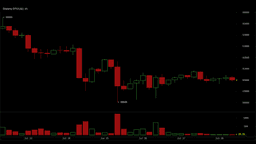
Michael Saylor’s latest orange-dot chart fueled fresh buy anticipation, showing 847,363 BTC and a reserve near $51 billion. The post followed two

Brazil stablecoin regulations could change the game for virtual asset providers. Learn about the proposed 24-hour hold period.

The European Securities and Markets Authority (ESMA) has directed unauthorized crypto asset service providers to stop accepting new EU clients and begin

XRP acts as a bridge currency, facilitating transactions between different fiat currencies in cross-border transfers. It ensures liquidity and allows for quick conversion of currencies across the Ripple network.
Low transaction costs are one of the core benefits of the Ripple network. On average, for transacting Ripple (XRP), the transaction cost is around 0.00001 XRP.
One can buy Ripple (XRP) directly on Bitcoin.com. Users can also trade XRP on exchanges like Binance, OKX, and Kraken with the help of our Ripple (XRP) Markets page, where you can access real-time XRP prices, a XRP candlestick chart, and expert analysis to make informed trading decisions.
Ripple (XRP) can be securely stored in hardware wallets like Ledger, as well as in software wallets such as Exodus and Trust Wallet, offering safe and accessible storage options.
XRP staking is not possible natively. Some centralized exchanges, such as Bitrue, offer XRP staking as an incentive to store XRP on their platform. Instead of staking, a common way for holders to earn APY on their XRP coins is decentralized lending on platforms such as Nexo.
While many participants in the Ripple ecosystem wonder if they can mine XRP and how to do it, there is no way to mine Ripple. The possibility of mining was deliberately excluded by the authors. The supply is limited to 100B XRP, and mining is not possible since all coins have already been emitted.
Financial institutions use Ripple for its speed and low transaction costs, which enable fast, low-cost cross-border transactions. Ripple is tailored for real-world applications in global payments.
Ripple’s established role in global payments has made XRP a notable asset in the crypto space. However, investment decisions should be made based on personal research and understanding of market risks.
While Ripple is primarily designed for cross-border transactions by financial institutions, XRP can also be used for other purposes and is accepted by some merchants, depending on the region and provider.
